Unsolved case / Japanese
The Shimoyama Incident: Conflicting Autopsies and the Body-Double Theory
This article summarizes what the featured video claims. It does not present those claims as established fact. Read the Japanese version.
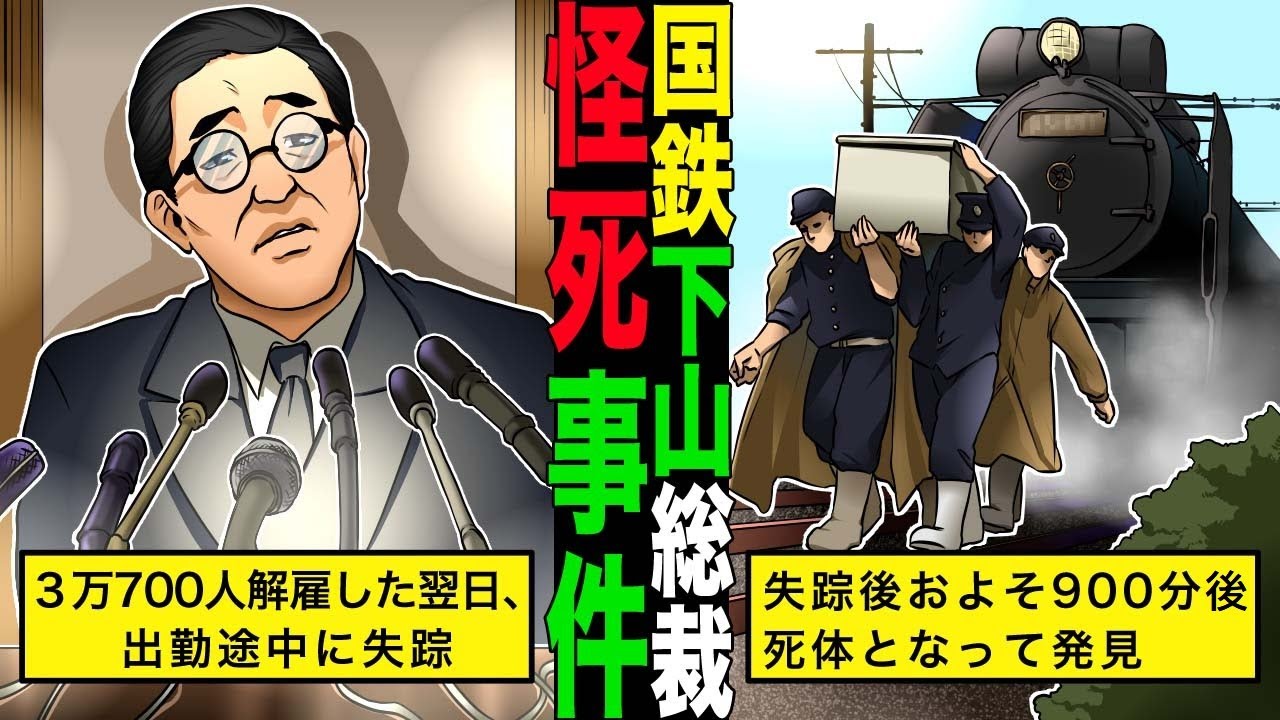
At about 9:37 a.m. on July 5, 1949, Sadanori Shimoyama, the first president of Japanese National Railways, entered the Mitsukoshi department store in Nihonbashi and never returned to his waiting official car. Early the next morning, his body was found on railway tracks in Ayase, Adachi Ward. The video asks why the missing hours and conflicting examinations produced a controversy that has lasted so long.
Sightings from Mitsukoshi to Gotanno
Reported sightings of Shimoyama—or of someone who closely resembled him—after his disappearance extended from inside Mitsukoshi to the Ginza subway line and the area around Gotanno Station. There were also accounts of a stay at an inn and sightings along the railway, but none established that the person was Shimoyama. The timeline leads to a freight train passing at about 12:20 a.m. and severing the body.
Struck before death or after?
The forensic pathologist who conducted the autopsy is said to have found no vital reaction in the injuries and suggested the possibility of murder, with the body placed on the tracks after death. A medical examiner who inspected the scene countered that internal bleeding also appears in people killed by trains and that the small amount of blood could have been washed away by rain, rejecting it as evidence of murder. The opinions split over whether he was struck before or after death, and in August 1949 the disagreement led to a forensic pathologist being called before the Diet.
Notice of 30,700 layoffs amid Cold War tension
Behind the case were early Cold War anticommunist policy and austerity under the Dodge Line, which put JNR under pressure to make mass staff reductions. The Japanese Communist Party had gained seats in an election, while the communist-aligned railway union took an increasingly confrontational stance toward the cuts. The video presents the incident's occurrence one day after JNR notified about 30,700 people of dismissal as part of the context that encouraged murder theories.
The Mainichi Shimbun, meanwhile, reported a suicide theory based on witness statements and forensic opinions. Records that Shimoyama had been diagnosed with a neurasthenic depressive state and was taking sleeping medication are also presented as support for that view, although no diagnosis should be asserted retrospectively from this account. The special investigative headquarters was eventually dissolved without announcing an official conclusion of either murder or suicide, and the investigation was reportedly scaled back.
Books and newspapers that sustained the body-double theory
A man who became JNR's second president later wrote in a magazine that the person seen at the inn was a double and that Shimoyama had been killed. Seicho Matsumoto also developed a body-double and murder theory in *Japan's Black Fog*, citing details including the absence of cigarette ends in the inn's ashtray. A book by an Asahi Shimbun reporter is said to have reached testimony suggesting involvement by a U.S. military-linked intelligence organization, but all of these remain unconfirmed theories introduced by the video. The three people involved in a 1999 *Weekly Asahi* series are also said to have later leaned toward murder, while the ending leaves the truth unresolved.
Viewer reactions
“It was probably the Communist Party and the labor union.”
14 likes
“I think it was murder. There is a hut near the overpass he supposedly jumped from, and there were traces of something being dragged from that hut toward the bridge.”
8 likes
“Please cover the unsolved case of the housewife who disappeared while gathering wild vegetables!”
7 likes
“It is one of the three major JNR mysteries.”
5 likes
“It was suicide. When someone becomes caught up in trouble that could turn into a major problem, they normally want to escape, but in this case perhaps death seemed like the only way. In reality, resignation should have been another option.”
4 likes
Following the theory
The chain of sightings beginning at Mitsukoshi divides at the body on the tracks and two opposing forensic opinions. As mass layoffs, the Cold War, newspaper reporting, and books about a body double are layered onto the case, one man's death expands into a question about postwar Japanese society. What finally remains is not the number of theories, but the gap left because none reached a conclusive resolution.
Watch the video
やじうま大学【実話アニメーション】
Key moments
- ▶ 0:32
The video follows the timeline from Shimoyama's disappearance at Mitsukoshi on July 5, 1949, to the discovery of the first JNR president's body near the Joban Line early the next morning.
- ▶ 3:23
It explains that University of Tokyo experts argued for postmortem dismemberment and murder, while medical examiners and Keio University experts argued he was struck alive and died by suicide.
- ▶ 5:23
A forensic pathologist was called as a witness before the House of Representatives Judicial Affairs Committee on August 30, 1949, turning the disagreement into a controversy involving both parliament and academia.
- ▶ 5:47
The video presents the early Cold War shift in occupation policy, GHQ austerity, and mass job cuts—including about 95,000 positions at JNR—as the case's background.
- ▶ 7:32
It traces political tension involving the Communist Party and the railway union, train sabotage, and the fact that the incident followed notice of 30,700 layoffs by one day.
- ▶ 9:42
The video describes how the Mainichi Shimbun reported the suicide theory based on witness statements, forensic opinions, and information about Shimoyama's health.
- ▶ 11:13
It says neither the First nor Second Investigation Division announced an official conclusion before the investigation was effectively reduced and ended from late 1949 into the following year.
- ▶ 11:59
The video follows the continuing revision of the murder theory through Asahi Shimbun reporting, Tsugumichi Kagayama and Seicho Matsumoto's body-double theory, and books published from 1999 onward.
Related topics
Found an error? Contact us.