Historical mystery / Urban legend
Five Mysteries of Aomori: From the ‘Center of Japan’ Stone to Misawa Air Base
This article summarizes what the featured video claims. It does not present those claims as established fact. Read the Japanese version.
From the roughly 15,000-year-old Odai Yamamoto site to an international trading port once said to have rivaled Kyoto and Hakata, the video begins its journey through Aomori as a land with an ancient history and many places that resist complete explanation.
What do the three characters ‘Center of Japan’ mean?
The first clue is the ‘Center of Japan’ stone monument, reportedly found upstream on the Aka River in Tohoku Town on June 21, 1949. The narrator layers together a legend that Sakanoue no Tamuramaro carved it with an arrowhead and the story of the Tsubo no Ishibumi, a celebrated poetic place name found in the *Shin Kokin Wakashu*. During the Edo period, another monument in Miyagi was regarded as the genuine one and even visited by Matsuo Basho, but its carved inscription was later said to date from the wrong period. Strangely, near the Aomori discovery site are a settlement named Ishibumi and a place named Tsubo. If ‘Japan’ in the Heian period meant the northeastern region called Hinomoto, the words could have meant ‘the center of Hinomoto’—the theory extends that far.
Was Tosaminato erased by a tsunami, or by the victors?
The story moves to Tosaminato, said to have prospered through continental and northern trade from the 13th through the 15th centuries. A famous story that the port sank overnight in a great 1340 tsunami is rejected because its source was judged a forged document and no tsunami traces were found. Chinese ceramics and the remains of a planned city, however, are presented as evidence that the prosperity itself was real. The video then turns to the Ando clan, aligned with the Southern Court, which was driven from the port by the Nanbu clan, aligned with the Northern Court and Muromachi shogunate, in 1432 and 1442. It suggests the victors may have rewritten the record, adding a story of ‘hidden nenbutsu’ rituals secretly preserved in the domain. The vanished port thereby becomes a tale of secrecy.
From Christ's grave to dace in an acidic lake
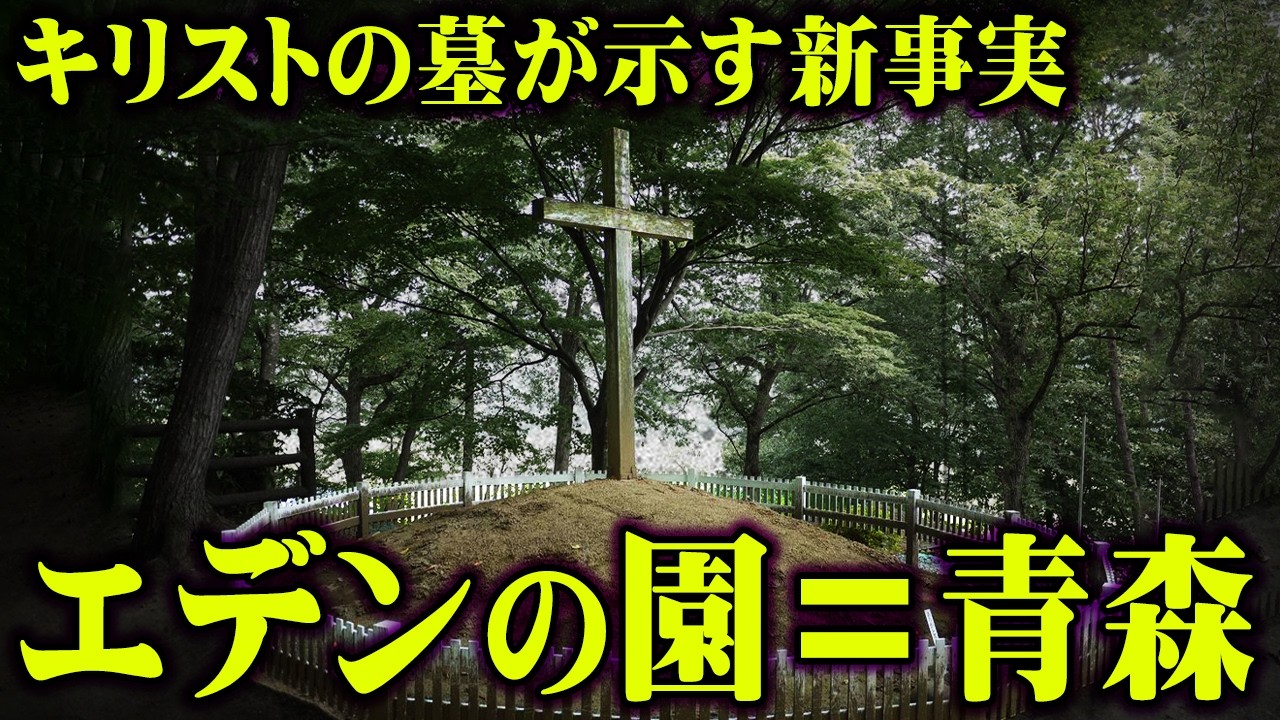
Next comes Shingo, where a legend says Christ escaped to Japan and died at age 106. The video says researcher Kiku Yamane declared Mayogatai the Garden of Eden, while Katsutoki Sakai identified nearby megaliths as one of Japan's pyramids. It adds testimony that an orientation stone points precisely north, south, east, and west and that compasses spin nearby. At Lake Usori on Mount Osore, an isolated population of dace adapted to strongly acidic water with a pH of 3.5 appears. The video overlays Ezekiel 47, in which water unable to sustain life becomes full of fish, and advances as far as its own interpretation that Christ created the first dace.
Misawa's black triangles and a final connecting line
As a modern blank space, the video places Misawa Air Base, jointly operated by the U.S. Air Force and Japan Air Self-Defense Force. Could the Anenuma communications site be part of the Echelon interception network? Is there a secret underground facility? Are the black triangles seen at night secret weapons or UFOs? Local rumors follow one another. The video even introduces a theory of a secret underground flight route toward Shingo. At the end it looks back over the monument, port, unusual natural environment, and base, concluding that gaps in the record left by power and war may have created the space into which Aomori's legends entered.
Viewer reactions
“At first glance, I thought there were two Koyakkys ꉂ🤣𐤔”
126 likes
“There is apparently a rock with Sumerian writing carved into it in the mountains of Kumamoto too. Something feels strange. Is this country really hiding that much?”
114 likes
“I hope lots of people come to Toya's Aomori event.”
76 likes
“Aomori also has the Buddha's grave. The place is called Daishaka in Aomori City, and there is even a Daishaka Station.”
69 likes
“I think the Jomon period was when Aomori had Japan's largest population. The Northern Fujiwara flourished in Iwate in the late Heian period, so various things may not be impossible.”
53 likes
Following the theory
A journey beginning with a single stone proceeds to a vanished port, Christ's grave, fish in an acidic lake, and a base that is difficult to enter. If one line connects the five places, perhaps it is not a single secret but the Aomori landscape itself, where stories grow wherever the written record breaks off. That is the lingering thought the video leaves behind.
Watch the video
コヤッキースタジオ
Key moments
- ▶ 3:36
The video interprets the ‘Center of Japan’ stone found in Aomori in 1949 through the legend of Sakanoue no Tamuramaro and a poetic place name in the *Shin Kokin Wakashu*.
- ▶ 12:01
It rejects the theory that a 1340 tsunami submerged Tosaminato and traces the port's real prosperity through Chinese ceramics and remains of a planned city.
- ▶ 14:58
The account suggests that the Ando clan was driven from Tosaminato in 1432 and 1442 and that the victorious Nanbu clan may have rewritten its history.
- ▶ 19:30
From the supposed grave of Christ in Shingo, the story expands to a legend that Mayogatai was Eden and to the Oishigami ‘pyramid,’ said to have been discovered in 1935.
- ▶ 23:40
The video connects dace adapted to Lake Usori's pH 3.5 water with the ‘water teeming with fish’ in Ezekiel 47.
- ▶ 28:21
It links B-1B deployments at Misawa Air Base, Echelon theories, and sightings of black triangles to rumors of secret facilities and UFOs.
- ▶ 32:35
Looking back across the five locations, the video concludes that gaps in the record left by rulers and wars helped Aomori's legends grow.
Related topics
Found an error? Contact us.